Deciding between Komodo and Raja Ampat for your custom-built Indonesian yacht is a choice between two distinct marine philosophies. Komodo offers accessible, dramatic landscapes with iconic megafauna, while Raja Ampat provides a remote, expedition-style voyage into the planet’s most biodiverse underwater realm.
- Komodo: Ideal for shorter itineraries, featuring reliable dragon sightings, strong current diving, and savannah-like islands close to Labuan Bajo airport.
- Raja Ampat: Suited for longer expeditions, boasting over 1,500 fish species in a vast, remote archipelago that demands a self-sufficient vessel.
- Seasonality: The primary differentiator is the cruising season; Komodo is best from April to November, whereas Raja Ampat’s prime window is October to April.
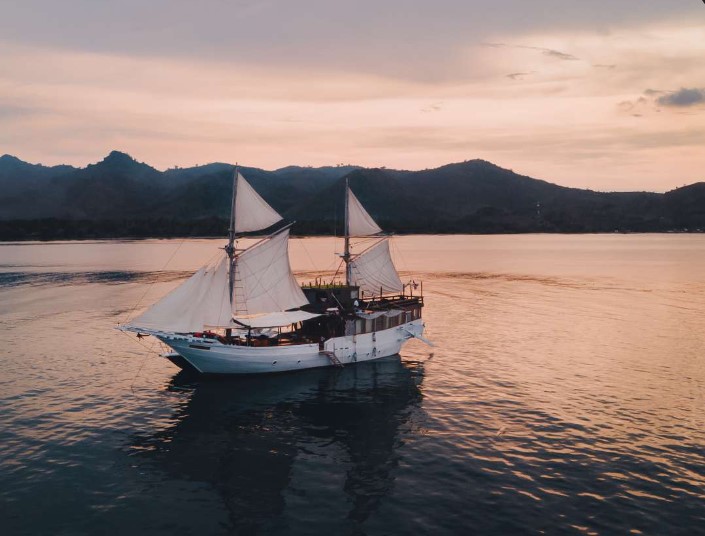
The teak deck of the phinisi is warm underfoot, the air thick with the scent of clove and drying sea salt. From the bow, the sea is a sheet of cobalt silk, broken only by the silhouettes of volcanic islands rising like ancient leviathans from the deep. This is the moment, the one that follows the decision to commission a vessel built for these waters. The question is no longer if, but where. In the vast Indonesian archipelago, two names dominate the conversation among seasoned seafarers: Komodo and Raja Ampat. As a travel editor who has spent considerable time navigating both, I can tell you the choice is far more nuanced than a simple glance at a map would suggest. It’s a decision that will, and should, influence the very design of your custom-built indonesian yacht.
The Primordial Realm: Komodo’s Terrestrial and Marine Drama
Sailing into the Komodo National Park is like entering a lost world. The islands are not the lush, tropical clichés of Southeast Asia; they are rugged, arid, and muscular, their savannah-like hillsides turning a burnished gold under the dry season sun. This is a landscape with a palpable, prehistoric tension. The main draw, of course, is the Komodo dragon (Varanus komodoensis), a creature of mythic proportions. Seeing a three-meter, 70-kilogram alpha male patrol a beach on Rinca Island is an experience that recalibrates your understanding of modern wildlife. But to focus solely on the dragons is to miss half the story. The waters that separate these islands are a cauldron of marine energy. The Indonesian Throughflow funnels immense volumes of water from the Pacific to the Indian Ocean here, creating currents that can exceed 8 knots. This nutrient-rich super-highway feeds a staggering concentration of life. At Manta Point, I’ve watched a dozen giant manta rays, some with wingspans over 5 meters, queue patiently at cleaning stations. At Castle Rock, grey reef sharks and giant trevally patrol the submerged pinnacle. The proximity of Komodo National Park to the rapidly developing town of Labuan Bajo (LBJ) is its greatest advantage and, for some, its primary drawback. A short 60-minute flight from Bali makes it exceptionally accessible for 7-to-10-day voyages. This accessibility means you will share the waters, but a well-designed yacht allows you to chart a course to more secluded anchorages, a world away from the day-tripper boats. For an owner who values convenience and high-impact encounters, both above and below the water, Komodo is an playground.
Raja Ampat: The Epicenter of Global Marine Biodiversity
If Komodo is a high-drama theater, Raja Ampat is the grand, sprawling library of life itself. Located off the northwest tip of Bird’s Head Peninsula in West Papua, the “Four Kings” archipelago is a staggering collection of over 1,500 jungle-clad islands and karst pinnacles. Its remoteness is its defining feature and its greatest protection. Getting here requires more commitment—a flight into Sorong (SOQ) and a readiness for a true expedition. This is a destination that demands a minimum of 10 to 14 days, and it’s where a long-range custom-built indonesian yacht proves its worth. The statistics are, frankly, hard to comprehend. As documented by Conservation International, the region holds the world record for fish species diversity; marine biologist Dr. Gerald R. Allen famously identified 374 species on a single dive at Cape Kri. According to UNESCO, which lists the area as a tentative World Heritage site, it contains over 75% of the world’s known coral species. The diving experience here is less about the adrenaline of big currents and more about the overwhelming immersion in biodiversity. It’s about spotting a pygmy seahorse the size of a fingernail clinging to a gorgonian fan, then looking up to see a school of a thousand barracuda blotting out the sun. The landscapes of Wayag and Misool, with their mushroom-shaped limestone islets, are iconic. A voyage here is a profound statement about exploration, conservation, and the desire to witness the planet at its most vibrant. For the owner who sees their yacht as a platform for discovery in the world’s last true wilderness, Raja Ampat is the undisputed champion.
Seasonality and Sailing Conditions: A Tale of Two Monsoons
The most critical logistical factor separating these two destinations is the weather. They operate on almost perfectly opposing seasonal schedules, dictated by the regional monsoons. This is a crucial consideration when planning your cruising calendar and even your yacht’s maintenance schedule. Komodo’s prime season runs from April through November. This is the dry season, characterized by calm seas, clear skies, and excellent visibility underwater. Water temperatures hover around a comfortable 26-28°C. From December to March, the northwest monsoon can bring rain and significantly rougher sea states, making some northern dive sites inaccessible. Conversely, Raja Ampat’s best window is from October to April. During these months, the seas are generally calm, and the weather is dry, offering ideal conditions for exploring its vast and complex waterways. Water temperatures are a consistently warm 28-30°C. From May to September, the southeast monsoon brings wind and rain, which can reduce visibility and make open-water crossings uncomfortable. For a yacht owner, this seasonal opposition presents a unique opportunity. A vessel can spend the European summer months in Komodo and then, with a repositioning voyage of approximately 1,200 nautical miles, be ready for the winter season in Raja Ampat. This allows for nearly year-round cruising in world-class destinations. However, planning such a move requires expert logistical support and a vessel built for long-distance travel, a topic detailed in the Indonesia Yacht Builder Pricing & Cost Guide which explores long-term operational costs.
The Onboard and Onshore Experience: Culture and Comfort
The character of your journey is shaped as much by the life onshore as it is by the sea. In this regard, Komodo and Raja Ampat offer vastly different experiences. The Komodo region, anchored by Labuan Bajo, has a more developed, albeit still rustic, tourism infrastructure. Provisioning is relatively straightforward, with access to markets and suppliers. The onshore excursions are spectacular but focused: trekking with rangers to see the dragons on Rinca, hiking to the tri-colored beach viewpoint on Padar Island, and enjoying sunset cocktails on a deserted pink sand beach. The cultural element is present but secondary to the raw nature. Raja Ampat is another universe entirely. It is one of the most sparsely populated regions on earth. Here, onshore activities are about genuine cultural immersion. You might visit a remote Papuan village to see how communities live in perfect symbiosis with the sea, or kayak into a hidden bay to view ancient handprints painted on limestone cliffs thousands of years ago. I once spoke with a veteran Phinisi captain, who put it best: “In Komodo, my chef can go to a market if we run low on limes. In Raja, the yacht *is* the market. Every single lime must be planned for and stored.” This reality has a direct impact on vessel design. A yacht destined for Raja Ampat must be a self-sufficient biosphere. This means larger-capacity freezers, commercial-grade water makers, sophisticated waste-management systems, and extensive fuel storage. The Definitive Indonesia Yacht Builder Guide emphasizes this “mission-first” design philosophy, ensuring the vessel is perfectly tailored to its intended environment.
Designing Your Vessel for the Destination
The decision between Komodo and Raja Ampat should fundamentally influence the conversation you have with your naval architect. Commissioning a custom-built indonesian yacht is not about a one-size-fits-all solution; it is about creating a tool perfectly honed for its purpose. A vessel intended primarily for Komodo could be a masterpiece of efficient design—say, a 35-meter phinisi with an emphasis on expansive, open-air deck spaces for entertaining and a shallower draft to access secluded coves. Its range requirements are less extreme, and its tenders need to be robust for frequent beach landings and dive excursions. The focus is on maximizing the 7-day charter experience. A yacht for Raja Ampat, however, is an expedition machine. We are talking about a vessel likely over 45 meters, engineered for autonomy. Long-range fuel tanks providing a 3,000+ nautical mile range are not a luxury; they are a necessity. A dedicated, climate-controlled dive center with multiple compressors and a nitrox blending system is standard. Redundant systems for every critical function, from navigation to refrigeration, are paramount. This is the ultimate brief for a premier indonesia yacht builder, challenging them to create a vessel that is at once a five-star private resort and a rugged, reliable platform for deep exploration. When you are ready to Book Indonesia Yacht Builder services, this initial conversation about your intended cruising grounds will be the most important one you have.
Quick FAQ: Your Komodo vs. Raja Ampat Questions Answered
Which destination is better for non-divers?
Komodo generally offers more for those who prefer to stay dry. The iconic Komodo dragon trekking, the dramatic hikes on Padar Island, and the unique geology of Pink Beach provide world-class terrestrial experiences. While Raja Ampat’s karst scenery is magnificent to witness from a kayak or tender, its primary allure is unequivocally beneath the waves.
What about the budget? Is one region more expensive to cruise?
Operationally, Raja Ampat is more expensive. Its extreme remoteness drives up costs for fuel, provisions, and logistics. Marine park fees are also a factor; the Raja Ampat Marine Park tag costs approximately $70 USD per person. While Komodo National Park fees have increased and can be complex, the overall running costs for a trip there are typically lower due to its proximity to supply chains. Our Indonesia Yacht Builder Pricing & Cost Guide provides a deeper analysis of these variables.
Can I visit both Komodo and Raja Ampat on a single trip?
While technically possible for a private owner with unlimited time, it is highly impractical. The two locations are separated by over 1,000 nautical miles across several seas, including the Banda Sea. This would entail a dedicated repositioning voyage of two weeks or more. Most owners and charter operators focus on one region per season to maximize their time in the destination.
How does the yacht build process account for these different environments?
This is the core of the custom-build philosophy. During the initial design consultations, we establish your primary cruising intentions. A yacht intended for Raja Ampat will have its engineering systems, storage capacities, and range prioritized for self-sufficiency. For a Komodo-focused vessel, we might allocate more of the budget and space to guest amenities and water sports equipment. You can explore this bespoke process in our The Definitive Indonesia Yacht Builder Guide.
Ultimately, the choice is not about which destination is superior, but which one aligns with the life you envision aboard your vessel. Is your dream defined by the raw, Jurassic power of Komodo, experienced in accessible comfort? Or is it the quiet, profound sense of discovery that comes from kaleidoscopic frontiers of Raja Ampat? The great privilege of creating a custom-built indonesian yacht is that the vessel becomes a physical manifestation of that vision. It’s a craft built not just with ironwood and steel, but with your specific aspirations as the blueprint. When you’re ready to translate those aspirations into a tangible reality, the master craftsmen and naval architects at Indonesia Yacht Builder are the partners you need. They don’t just build yachts; they build the keys to the last truly wild places on Earth.